Sunday, May 17, 2020

Why Your Private Cloud is a Terrible Idea


Sam Newman gives a devastating analysis of the suicidal trajectory of Enterprises that are late adopters of public cloud services.  Watch the video.  If you aspire to be a "high performing" team, you are 24X more likely to succeed against competitors if you accelerate your move to the public cloud.  In my "day job" we are watching our own slow motion train wreck.  I may write a sequel to In Search of Stupidity.


Saturday, May 16, 2020

Dial Out -- Zoom Features you should be using (1 of 10)

TL;DR


  1. On Windows type Alt-I ; on Mac type Command-I

  2. Type invitee-name <tab> invitee-phone-number

  3. Click "Call" button

Background


At my company we have standardized on the Zoom video conferencing software, replacing a handful of other expensive, bad, frustrating systems in our conference rooms, computers, and desktops.  Zoom has very many interesting features to explore that are not immediately obvious.  This article is part of a series I am writing to walk you through some of the most useful features.  (Screenshots in these articles are from a Mac.  The Windows and Mobile Zoom programs are almost identical.)

Dial out to a mobile phone

It is not hard to imagine you are in a Zoom meeting with a large number of people but someone with important information for a decision or action is not present.  No problem: add that person to your Zoom meeting by dial-out:


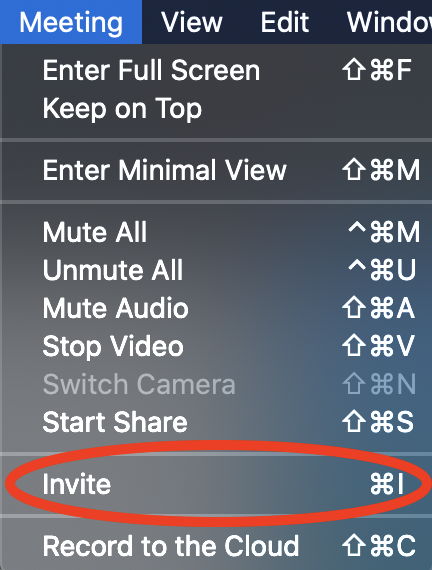
At the top of your Zoom application is a menu header called "Meeting:"

You can select the "Invite" option from the menu or use the keyboard shortcut (on a Mac the shortcut to add a participant to your meeting is command-I; on Windows it is Alt-I).


A dialog appears.  Fill in both the name and phone number.  Click the "Call" button.


The Reality Dysfunction by Peter F Hamilton


Great writing, terrible science, thrilling.  4/5 Stars.

Thursday, May 14, 2020

Istio services mesh resource list


Here is a cool github repository for resources and learning about the Istio services mesh.  I worked with the developers of Istio during early beta testing before the v1.0 release. The Istio developers discussed features my teams needed and how they would like to use them.  I love the approaches and design patterns Istio uses.  In particular, if you have a complex mesh with performance sensitive micro-services that do not connect through Istio, you can align logging time stamps of your services by logging to the same prometheus / grafana system.

Deserted Island DevOps

Sometimes you feel as if you woke up in the twilight zone.  The Deserted Island DevOps conference was held entirely inside a Nintendo Switch video game called "Animal Crossing New Horizons" and live-cast on twitch.tv.  Videos of the talks are here.

Tekton Toolkit

The choices in DevOps toolkits and approaches to containerized public cloud continuous integration / continuous deployment (CI/CD) methods and tools is crowded.  Older, failed approaches from companies that previously provided infrastructure management like Puppet Labs and Chef have transmogrified themselves to offer more modern approaches.

Puppet Labs has released part of their new framework as free open source software (FOSS); they call this toolkit Tekton (cool name).  Eric Sorenson takes us on a two-part tour of what's new in Tekton and what Puppet Labs plans to do with the toolkit other than evolving Jenkins-X.

Will it catch on?  Leave a comment.

Wednesday, May 13, 2020

Absolute Beginner's Guide to git actions from pull requests (GitOps)

Sander Knape takes us on a clear step-by-step explanation of git actions through the motivating example of auto-deployment from a pull request.  Oppa GitOps style!

internal "platform" products

Software developers enjoy calling their code libraries and reusable components a "platform." And they feel rewarded when other developers use their components, libraries, or APIs.  The fantastic service we enjoy from free, open source software (FOSS) platform components is a direct result of this propensity and "reward" the developers feel when others use their code.

All public cloud providers have profit-oriented "platforms" that include APIs, libraries, & components, with associated documentation, support, tutorials, videos, certifications, evangelists, and free consulting.  These "true" platforms are often very comfortable to use and can enable rapid development with less maintenance cost than from-scratch development, even when developers use open source components.

In most big companies, including where I work, large teams of developers are often tasked with building what they call internal "platforms."  Unfortunately, these internal platforms have many challenges. Camille Fournier writes about a few of these challenges and her recommendation for remedies.  The challenges she address are: a small, captive audience with whom it is hard to empathize, and an odd tendency to build too much into a platform that is never or infrequently used.  Her remedies are spot on and I recommend you skim the article to see what worked for her.

Monday, May 11, 2020

5 terrible AWS services you should avoid -- for now


David Lin takes us on a fun adventure of how terrible a few AWS services are (currently) and why you should avoid them at least until their next major releases. For the impatient, the services are:
  1. Cognito
  2. CloudFormation
  3. ElasticCache
  4. Kinesis
  5. Lambda
I disagree with David on this last one (Lambda).  If you embrace our serverless no-ops future, then you must refactor your object models and separate your concerns differently in your designs to keep the right number of end-points for your needs and your organization.  David's argument is that if you were to factor your services his (per-end-point) way, you would have explosively many web functions.  I challenge his assumption.

Lots of good news!


Researchers have identified an antibody that blocks both SARS-CoV-1 and -2 from infecting cells in culture and have already obtained the DNA that encodes this specific antibody and have made a human version of it.  As the authors note, we already know that therapies and vaccines based on this approach are effective.

 # 
 

Coronaviruses code for big proteins that are inactive until they are cut into smaller pieces.  Proteases slice them into bad, functioning proteins. Inactivating the proteases would block viral infection. Existing, human-safe protease inhibitors were screened against SARS-CoV-2's enzymes. One of those, carmofur, turned out to be effective; this study shows how it's able to bind the SARS-CoV-2 protease and inactivate it.  Woot!
 
 # 
 
One more:  Where will we get all those human antibodies we need for treatments?  People are currently giving them away.  I think the evil insurance companies should pay the donors in a free, open market-based system.